ALL MODULES

Every Converge module

Converge is browser-based field-modelling software for oil and gas, organised the way a field study runs: fluids first, then wells, reservoir, surface and money. Every module reads the project's one fluid. Each card says what the module does, and the benchmarks page shows how each engine is checked.

An engineer seated at a bank of monitors in a modern operations room, with a large curved display ahead.
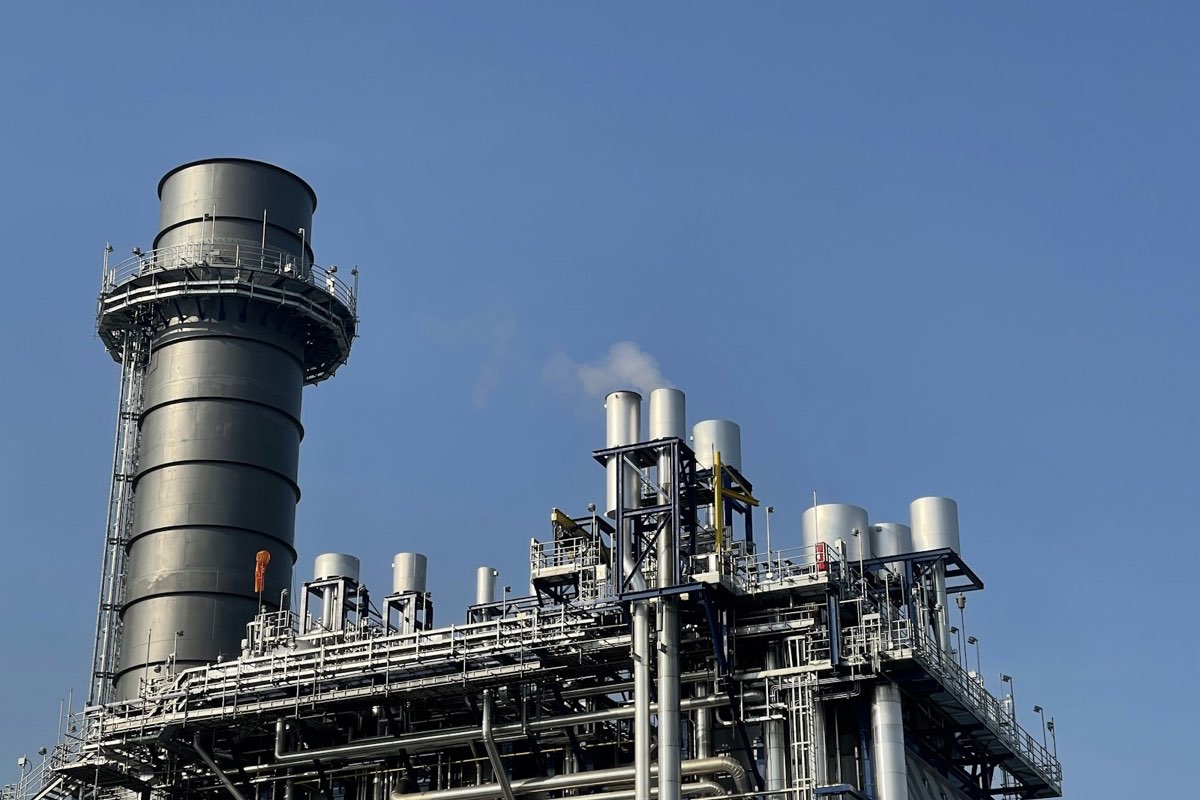
A gas processing plant with a tall steel stack and pipework against a clear blue sky.

FLUIDS

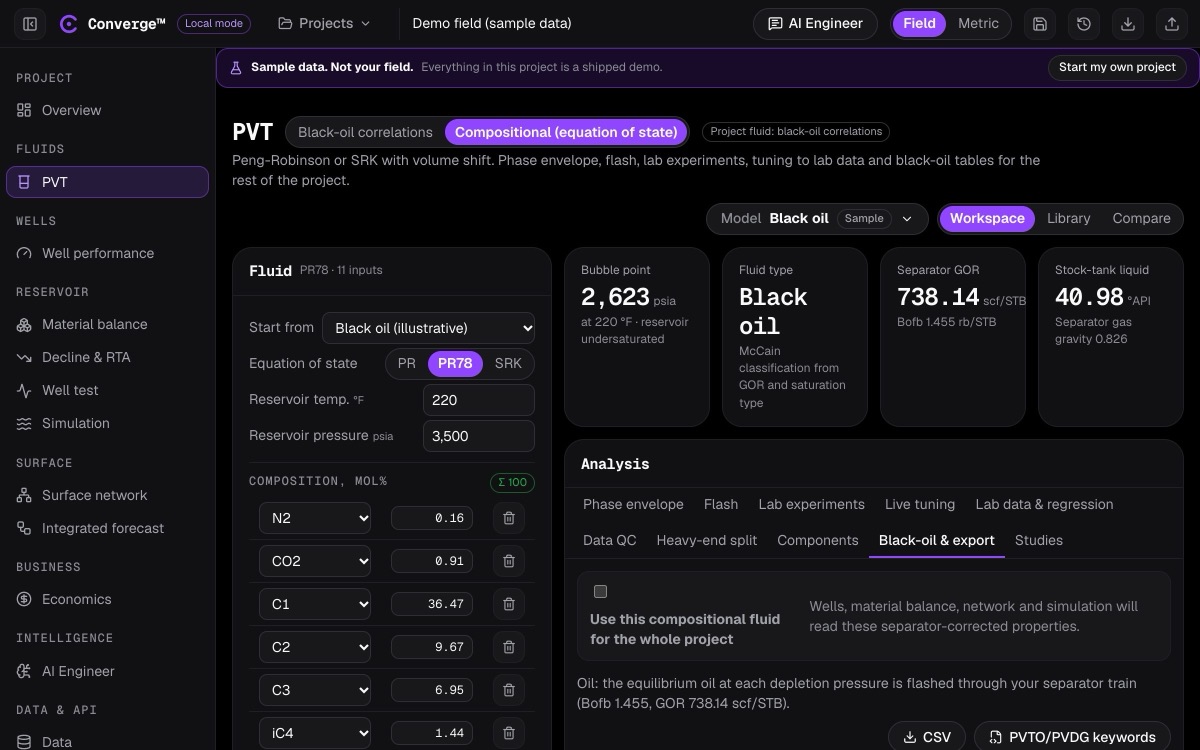
Compositional PVT

A full equation-of-state workbench. Describe the fluid from a lab composition, split and lump the plus fraction, match the lab experiments, then hand black-oil tables or a compositional deck to the rest of the project.

  • Peng-Robinson 1976 and 1978, SRK, Peneloux volume shift
  • Gamma-distribution split of the plus fraction, custom lumping
  • Stability, flash, bubble and dew points
  • Phase envelope with quality lines and critical point
  • CCE, differential liberation, CVD, multistage separator
  • Swelling test and separator optimisation
  • Regression with bounds, weights and per-point exclusion
  • Live tuning, run history, undo and compare
  • LBC viscosity, hydrate screening
  • Model library: several fluids per project, compare envelopes
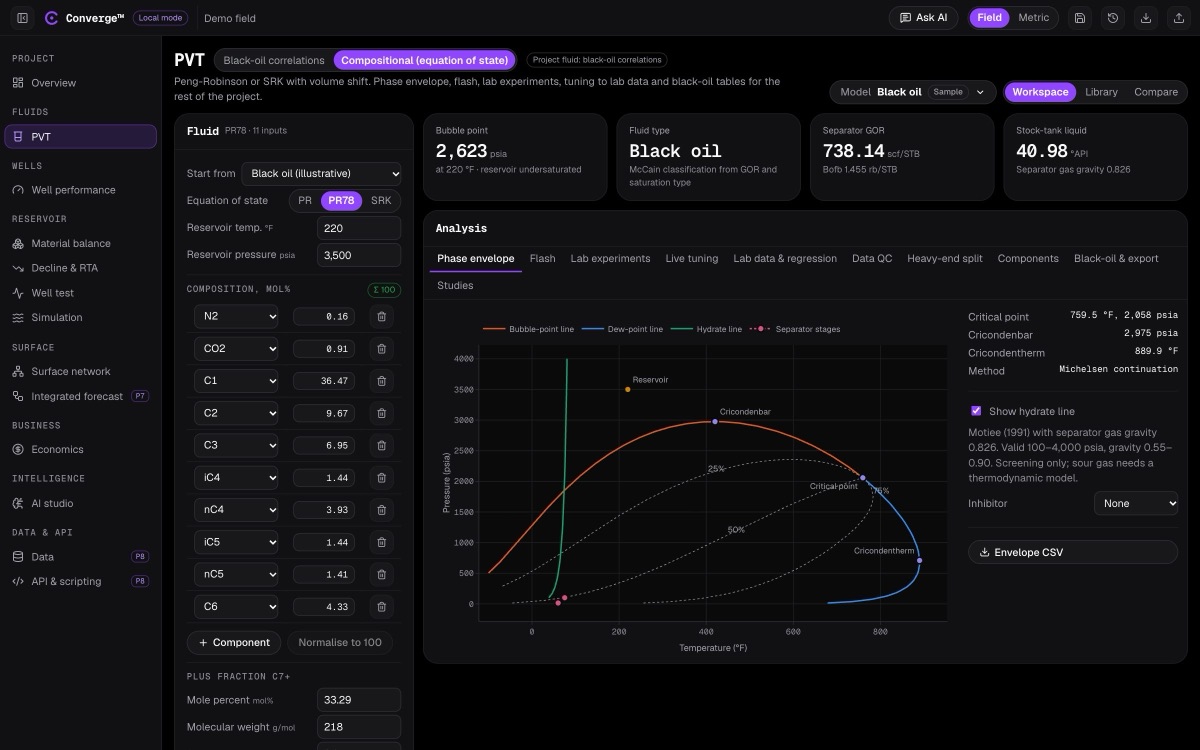
Converge compositional PVT screen: fluid composition table, saturation pressure and other readouts across the top, and a phase envelope with bubble-point, dew-point and quality lines.
Phase envelope for a sample fluid.
Full module page

FLUIDS

Black-oil PVT

When a full composition is more than the job needs, start from oil gravity, gas gravity and GOR. Published correlations give oil, gas and water properties against pressure, compared with your lab points.

  • Oil, gas and water properties from correlations
  • Honour a measured bubble point
  • Lab match plots and tables
  • Tables flow to every other module
Full module page

FLUIDS

Simulator exports

The tuned fluid leaves Converge in the format your next tool expects: nodal, material-balance, network and simulator models. Black-oil tables come from flashing the equilibrium oil through your separator train, not from the reservoir flash.

  • Black-oil PVT tables for nodal, material-balance and network models
  • PVTO / PVDG and PVTW for black-oil simulators
  • PVTG / PVTO for wet gas and condensate
  • *PVT keyword-format black-oil table
  • Compositional EOS deck (keyword format) and EOS block
  • RSVD / RVVD initialisation tables
  • CSV of every table
Converge black-oil and export screen: oil formation volume factor, solution GOR and viscosity against pressure, with a table of black-oil properties and export buttons.
Separator-corrected black-oil tables, ready to export.
Full module page

INTELLIGENCE

AI Engineer

Reads a lab report in PDF, Excel or Word, builds the fluid model, runs the engineering calculations you ask for and explains the results. Tuning creates draft revisions; it never edits a model in place. It works with the major cloud AI providers. Read how it works.

  • Every number it quotes is traced to a model calculation
  • Lab measurements are labelled as lab rows, never as model output
  • Gauge pressures are converted to absolute before any comparison
  • Falls back to another configured model if one is unavailable
  • Reads saved results from every module in the project

WELLS

Well performance

Inflow and outflow on the project fluid, with nodal analysis to find the operating point.

  • PI, Vogel, Fetkovich, Jones, Darcy with skin
  • Gas back-pressure, Joshi horizontal inflow, fracture equivalent skin
  • Hagedorn-Brown, Beggs-Brill, Gray, Duns-Ros
  • Deviation survey and temperature
  • Nodal analysis, sensitivities, lift-curve export
  • Gas-lift performance curves, ESP stage curves, chokes and liquid loading
Full module page

RESERVOIR

Material balance

Tank models on the project fluid, from diagnostic plots to a history match and forecast.

  • Oil, gas and condensate tanks with gas cap
  • Schilthuis, Fetkovich, van Everdingen-Hurst, Carter-Tracy aquifers
  • Havlena-Odeh, Campbell, Cole and p/Z plots
  • Drive indices
  • Automatic history match and forecast
  • Multi-tank
Full module page

RESERVOIR

Decline & RTA

Decline models fitted to production history, with uncertainty bands.

  • Arps, modified hyperbolic, Duong, stretched exponential
  • Automatic fit, best model ranked by AIC
  • P90 / P50 / P10 bands and type wells
  • Batch decline across a field, with a per-well QC table
  • Rate-transient type-curve match for oil wells
  • Linear-flow analysis and flowing material balance
Full module page

RESERVOIR

Well test

Pressure-transient analysis from diagnostics to a regressed analytical model.

  • Log-log derivative diagnostics
  • Horner and MDH
  • Analytical models with boundaries, dual porosity and fractures
  • Changing storage, radial composite, partial penetration
  • Automatic regression with 95% confidence intervals
  • Deconvolution of the full rate history
Full module page

SURFACE

Surface network

Gathering networks built on the same wells and fluid, solved and optimised together.

  • Drag-and-drop gathering network
  • Multiphase pipelines, chokes, compressors, separators, erosion checks
  • Network solve
  • Gas-lift and choke optimisation
Full module page

RESERVOIR

Simulation

A grid simulator that reads the project fluid directly.

  • Three-phase black-oil grid simulator
  • Wells with rate and pressure controls, schedules
  • Pressure and saturation maps over time
Full module page

SURFACE

Integrated forecast

Reservoir, wells and network run together through time, so a change in one shows up in the others.

  • Reservoir, wells and network coupled through time
  • Scenario comparison
  • Field-development screening
Full module page

BUSINESS

Economics

Cash flow and fiscal terms on your production profile.

  • Cash flow, NPV, IRR, payback, breakeven
  • Royalty, tax and production-sharing terms
  • Nigeria PIA 2021 fiscal templates, as screening values
  • Nominal or real money, results in US dollars and naira
  • Monte Carlo economics
  • Emissions cost and gas flare penalty
Full module page

DATA

Data

Bring production data in from spreadsheets, check it, fix it and allocate it, then send clean history to decline and material balance. Every change is logged.

  • CSV, TSV and Excel import with column, unit and date detection
  • 17 validation checks, with one-click fixes where safe
  • Allocation by well test and hours on, with BS&W and shrinkage
  • Anomaly detection and virtual flow metering
  • Audit trail of every change
  • CSV, Excel and JSON export
Full module page

AUTOMATION

Integrations

Run the engines from code. The same calculations you use on screen are available to scripts, to your own systems and to AI assistants.

  • Scripting editor with worked examples, in Field or Metric units
  • REST API, documented with OpenAPI
  • MCP server for any MCP-compatible AI assistant
  • The same engine functions behind all three
Full module page

PROJECTS

Projects and versions

One project holds the fluid, wells, units and history. Your own projects start empty, so no sample value ever leaks into real work.

  • One shared project fluid read by every module
  • Read-only Sample field with guided tutorials
  • Make a copy of the Sample field to edit it
  • Typical values are badged until you replace them
  • Version history with named versions
  • Compare two versions field by field

Start with a fluid you know.